Climate Action
Approaches to Climate Change
The NIPPN Group conducts its business by benefiting from the blessings of the Earth, which are grains, vegetables, and seafood. We recognize that business activities throughout the entire supply chain, from the procurement of these materials to manufacturing, logistics, and processing, have a significant impact on the environment.
In order to maintain a sustainable food system, we recognize that responding to climate change is an urgent issue for the continuation of the NIPPN Group’s business and our social responsibility.
TCFD
Introduction
In 2023, the Group expressed its support for Task Force on Climate-Related Financial Disclosures (TCFD), and we are actively promoting information disclosure in four areas : governance, strategy, risk management, indicators and targets based on the TCFD recommendations.

Governance
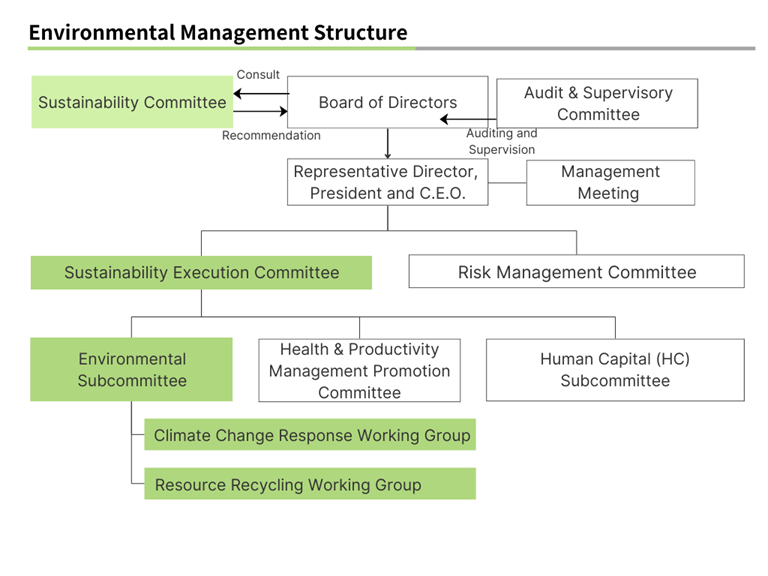
The NIPPN Group considers initiatives to address sustainability issues to be a management issue, and has established the Sustainability Committee, chaired by the Representative Director, President and C.E.O. Comprising outside directors with specialized knowledge and other officers, the committee is an organization that direct reports directly to the Board of Directors and monitors and controls sustainability-related risks and opportunities (the Sustainability Committee meets about twice a year).
The Committee will examine the sustainability of society from various perspectives from a long-term perspective, deliberate on the Group's sustainability direction, materiality, and strategy, including climate change, and issues recommendations to the Board of Directors. In response, the Board of Directors approves the materiality and determines basic strategies based on sustainability.
In addition, we established the Sustainability Execution Committee to identify, evaluate, and manage sustainability-related risks and opportunities, and in addition to the Environmental Subcommittee, we established the Health & Productivity Management Promotion Committee and the Human Capital (HC) Subcommittee in human capital management, which share the same direction as sustainability-related information disclosure, as subordinate organizations of the Sustainability Execution Committee. These committees are responsible for implementing cross-sectional initiatives and are headed by the Representative Director, President and C.E.O.
Risk Management
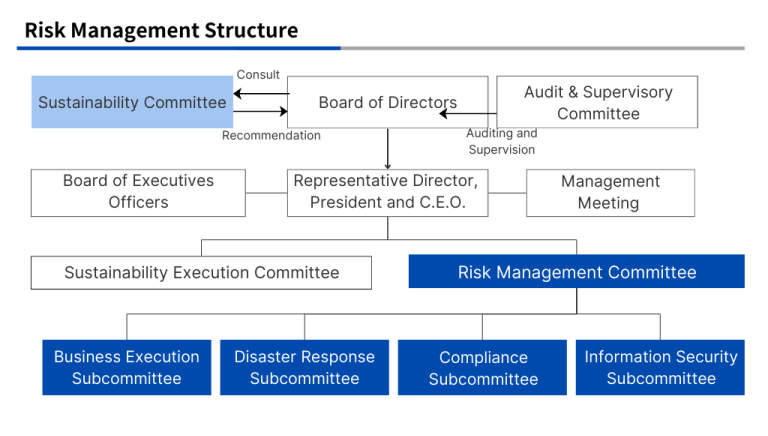
Climate change risks are discussed by the Environmental Subcommittee, which is a subordinate body of the Sustainability Execution Committee, and shared with the Risk Management Committee, which handles company-wide risks. The Risk Management Committee then identifies risks facing the NIPPN Group, prioritizes major risks, and develops countermeasures. Different cases are handled by four subcommittees within the Risk Management Committee: the Business Execution Subcommittee, Disaster Response Subcommittee, Compliance Subcommittee, and Information Security Subcommittee.
Strategy
Scenario Analysis
The NIPPN Group will continue to create value through the continuation of sustainable business, and recognizes that in order to realize a sustainable society, it is important to evaluate potential business impact from the risks and opportunities posed by climate change and to plan and implement countermeasures. We began scenario analysis in 2023 for our core Flour Milling business, and in 2024 we expanded the scope of our analysis to our Food business. We identified climate change risks and opportunities for 2030 and 2050 assuming a world in which global temperatures will have risen by 1.5°C and 4°C. Going forward, we will identify assess the importance, and develop countermeasures. We will then update our management strategies with more specific measures to address the risks and opportunities of climate change, while also taking CO2 emissions reduction measures to achieve our targets for FY2031.
| 4 ℃ | 1.5 ℃ | ||
|---|---|---|---|
| Main scenarios used | Transition scenario IEA World Energy Outlook (WEO) 2022 | STEPS | NZE |
| Physical scenario IPCC Fifth Assessment Report (AR5) | RCP8.5 RCP6.0 | RCP1.9 | |
| Timeline based on worldview | 2030 and 2050 | ||
| Businesses analyzed | Flour Milling business and Food business (frozen foods, food materials, processed foods) in Japan | ||
IPCC: Intergovernmental Panel on Climate Change
Impact Assessment and countermeasures
Risks
| 1.5℃ Worldview ■ Risks associated with the transition to a decarbonized society: High ■ Physical risks such as extreme weather:Low ✓Climate change countermeasures will be strengthened, and the target for reducing greenhouse gas emissions will be tightened. ✓With the transition to a decarbonizing society, operating costs will increase due to the introduction of carbon pricing and the shift to renewable energy. ✓By 2030, all new buildings will be ZEB (net Zero Energy Building), and by 2050, more than 85% of existing buildings will be ZEB, so the cost of infrastructure development will be increased. ✓The ratio of renewable energy to total power generation volume will reach 61% in 2030 and 88% in 2050. ✓As consumers' consumption patterns change, there will be an increasing demand for products and services that have a low environmental impact, as well as for recyclable and reusable ones. ✓As Interest in low-carbon technology and energy-saving will increase, environmentally friendly business activities will increase corporate value. ✓ESG investment, green bonds, and carbon credits will accelerate to raise funds through credit creation and sales, etc. |
| Type | Events | Risk | Impact for Profit | Solutions | |
|---|---|---|---|---|---|
| Trasition risks | Policy/Regulation | Carbon tax/carbon price | ・Increases in the carbon price will result in broad-based increases in costs throughout the supply chain (raw material procurement, manufacturing, logistics, energy, disposal, etc.) | Large | ・Introduction of photovoltaic power generation systems ・Switching to renewable energy ・Switching to high-efficiency equipment ・Utilization of joint logistics and modal shifting ・Visualization of the financial impact of introducing internal carbon pricing |
| New regulations to promote decarbonization | ・Increases switching cost of raw materials and packaging materials in respondse to strengthened policies for food loss reduction and the consumers' desire to reduce food loss | Medium | ・Development of environmentally friendly manufacturing methods ・Proactive collaboration with material and container/packaging suppliers ・Considering alternative materials | ||
| Technology | Transition to low-carbon technology | ・Increases development costs and capital investment costs as environmentally friendly products and services shift to low-carbon types. | Medium | ・Decline in the Company’s market share due to increased demand for low-carbon products caused by heightened environmental awareness ・Enhance environmental awareness regarding procurement, and loss of business opportunities due to delays in responding | |
| Market | Adapting to a decarbonizing society | ・Decline in the Company’s market share due to increased demand for low-carbon products caused by heightened environmental awareness ・Enhance environmental awareness regarding procurement, and loss of business opportunities due to delays in responding | Large | ・Development of low-carbon products ・Promote environmentally friendly procurement ・Procurement of certified materials | |
| Reputation | Reputation with stakeholders | ・If climate change response is inadequate, reputation with stakeholders will be damaged. | Large | ・Response to climate change and appropriate information disclosure | |
| 4℃ Worldview ■ Risks associated with the transition to a decarbonized society: Low ■ Physical risks such as extreme weather:High ✓Climate change countermeasures will not be required beyond the current level, and transition risks can be kept at a certain level. ✓The use of energy derived from fossil fuels will continue, and the use of renewable energy will remain limited. ✓However, demand for energy-saving technology will increase due to cost considerations. ✓As global warming progresses, extreme weather (typhoons, torrential rain, etc.) become more severe, and the physical damage to our company's bases and employees will increase. ✓The risk of physical damage to business partners and business stagnation due to the disruption of the supply chain will increase. ✓The growth environment for raw materials will change due to rising temperature and water risks, and the procurement cost for raw materials will increase. ✓The development of social infrastructure to prepare for disasters caused by climate change will accelerate. ✓Due to rising temperatures, the working environment will change and infectious diseases will increase, and there will be increasing risks that performance of business partners will deteriorate. ✓Demand for disaster management and disaster recovery products will increase (development of shelf life extension and packing technologies will progress). |
| Type | Events | Risk | Impact for Profit | Solutions | |
|---|---|---|---|---|---|
| Physical risks | Acute risks | Increasing severity of extreme weather | ・Decline in revenue due to shutdown of plants and mills caused by wind and flood damage ・Decrease in production efficiency due to severe water shortages in grain-producing regions | Large | ・Capital investment to deal with damage caused by wind and floods ・Securing multiple suppliers ・Breeding drought-resistant varieties ・Identifying and responding to areas affected by wind and flood damage |
| Chronic risks | Changes in rainfall patterns, Extreme fluctuations in weather patterns Rising average temperatures | ・Rising temperatures and chronic irregular precipitation causing changes in suitable cultivation areas, lower yields and quality deterioration of agricultural products, leading to higher raw material prices and manufacturing costs ・Increase in the cost of procuring raw materials due to a change in procurement routes ・Increase in procurement risk due to a temporary suspension of business activities at the purchasing site | Large | ・Securing multiple suppliers ・Breeding drought-resistant varieties ・Identifying and responding to areas affected by wind and flood damage ・Strengthening the purchasing site engagement | |
| ・Increase in the cost of procuring raw materials due to reduced crop yields and deteriorating quality caused by the spread of crop damage from pests and diseases | Large | ・Securing multiple suppliers ・Breeding of varieties resistant to pests and diseases | |||
Opportunities
| Type | Events | Risk | Impact for Profit | Solutions |
|---|---|---|---|---|
| Resource efficiency | Efficient use of transportation Efficient production and distribution processes | ・Reducing transportation costs by switching to more efficient means of transportation and improving vehicle loading efficiency | Large | ・Adopting modal shifting ・Standardizing product packaging |
| Use of recycled materials | ・Reducing the environmental impact and procurement costs by using recycled materials | Medium | ・Establishing a recycling scheme for logistics pallets | |
| Products and services | Use of new technologies | ・Increased sales of products with low environmental impact and products that meet the demand for reducing food loss | Medium | ・Development of environmentally friendly products and technologies |
| Market | Changes in consumer behavior and preferences | ・Increasing demand for alternative protein (Plant-based Food/PBF ) products due to rising health needs and an increasing ethical awareness ・Rising temperatures will lead to increased demand for easy-to-prepare foods such as frozen foods, as well as products that require short cooking times | Medium | ・Development of alternative protein products ・Usage of products made from sustainable raw materials ・Development of environmentally friendly manufacturing methods and products |
| Access to new markets | ・Rising demand for alternative proteins (Plant-based Food/PBF) due to population growth in emerging countries | Medium | ・Development of alternative protein products ・Usage of products made from sustainable raw materials ・Global survey of consumer demands. ・Strengthen global communication | |
| Resilience | Resource replacement/diversification | Diversify raw material suppliers to reduce costs and the risk of unprocurement | Small | ・Identifying procurement risks ・Strengthening supplier communication |
Metrics and Targets
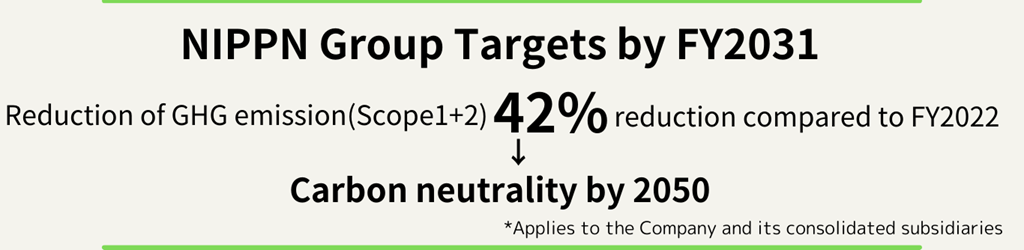
At the NIPPN Group, we consider addressing climate change to be one of the most important issues for achieving our corporate philosophy. As GHG emissions contribute to climate change and have a negative impact on food sustainability, we have set a target of reducing total Scope 1 and Scope 2 GHG emissions by 42% compared to FY2022 by FY2031. We will implement specific initiatives to achieve carbon neutrality by 2050.
Management of GHG Emissions
GHG Emissions
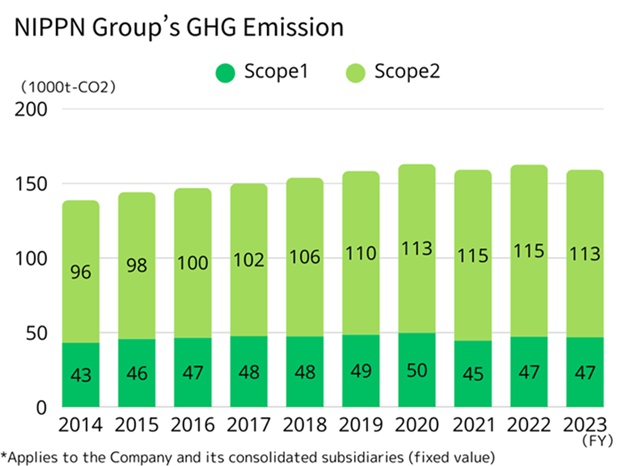
Socpe 1+2 Emissions in Japan and 0verseas and Intensity Management
| FY2022 | FY2023 | FY2024 | ||
|---|---|---|---|---|
| GHG emissions (1,000t-CO2) | Japan | 153 | 154 | 151 |
| Overseas | 9 | 9 | 9 | |
| Total | 162 | 163 | 160 | |
| CO2 emissions intensity (t-CO2/1,000t) | 86.0 | 84.7 | 82.0 |
Scope 3
In calculating Scope 3 for FY2024, we expanded the scope target of calculation to our food business in addition to the flour milling business.
| Scope 3 Category | GHG Emissions (1,000t-CO2) |
|---|---|
| Category 1: Purchased goods and services | 2,839.15 |
| Category 2: Capital goods | 37.63 |
| Category 3: Fuel- an energy-related activities (not included in Scope 1 or 2) | 11.87 |
| Category 4: Upstream transportation and distribution | 450.87 |
| Category 5: Waste generated in operations | 0.87 |
| Category 6: Business travel | 2.07 |
| Category 7: Employee commuting | 0.86 |
| Category 9: Downstream transportation and distribution | 15.49 |
| Category 11: Use of sold products | 33.19 |
| Category 12: End-of-life treatment of sold products | 0.26 |
| Countermeasure | Details | |
|---|---|---|
| ① | Equipment investment for the realisation of a decarbonised society | Adoption of energy-saving equipment Installation of photovoltaic power generation equipment |
| ② | Promotion of product development using low-carbon raw materials and materials | Switching to recycled pallets Development of products using alternative raw materials |
| ③ | Procurement of raw materials using transport methods with low GHG emissions | Purchasing wheat produced in Japan Switching to ship transport |
| ④ | Reducing procurement risks by strengthening the BCP | Reinforcement of storm surge countermeasures Ensure water procurement risk assessments |
Climate Change
The NIPPN Group considers climate change response as a key management issue. Climate change, which will lead to more severe and increased extreme weather events such as drought and heavy rainfall, is one of the factors that will lead to a decrease in the harvest of wheat, the raw material of our main products. Rising average temperatures will also lead to a decrease in yield and quality of wheat, as well as a risk of higher raw material costs, which may make it more difficult to continue providing consumers with products of stable quality and could largely affect consumers' eating habits. These issues will be addressed as they relate to the Company's credit risk.
Meanwhile, we are using this as a good opportunity to work on new product development, building advanced flour milling technology to maintain the quality of wheat and promoting the development and the sale of high-value-added products in the healthcare business that utilize new materials.
We will continue to position our response to climate change as a key issue for our company and promote initiatives to address it.
In addition, we are optimizing our procurement functions and promoting sustainable procurement by consist management from development to purchasing in the Raw Materials Procurement Div.
As a measure to reduce energy consumption and GHG emissions from our business activities, we are proactively adopting equipment that can reduce energy consumption and installing photovoltaic generation system into our plants. We are also actively shifting to marine freight transport for the transport of raw materials, which emits less CO₂.
Conversion to renewable energy
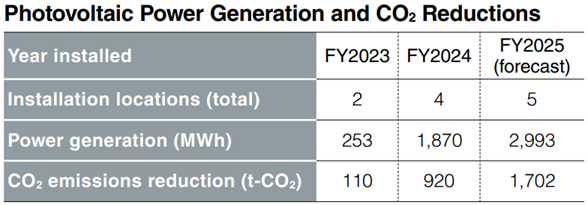
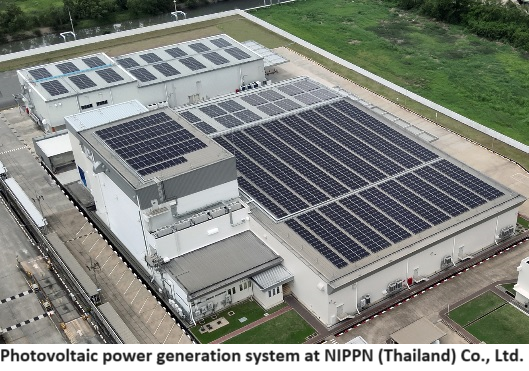
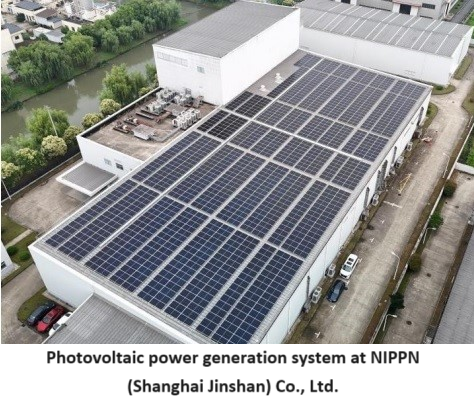
In order to make more use of renewable energy, following the installation of photovoltaic power generation systems at the Isesaki Frozen Plant and Ryugasaki Frozen Plant in Japan, which manufacture frozen foods, we have installed and started operating photovoltaic power generation system at NIPPN (Thailand) Co., Ltd. a premix and frozen dough manufacturing base in Thailand, and NIPPN (Shanghai Jinshan) Co., Ltd, a premix manufacturing base in China. The combined annual power generation for two site is expected to be approximately 1,580 MWh , which is expected to reduce CO2 emissions by 1,160 t-CO2 per year. We will also install these systems at Group companies in Japan and overseas in the future.
Initiatives in Logistics
GHG Reduction
| FY2022 | FY2023 | FY2024 | |
|---|---|---|---|
| CO₂ emissions (1,000t-CO₂)※1 | 47,768 | 52,645 | 54,393 |
| Energy use per product volume (kl/M ton-kilo)※2 | 30.4 | 32.7 | 33.0 |
※2 ton-km:1 ton-km is defined as 1 tonne of goods by transportation over a distance of 1 km
Improving Loading Efficiency by Changing Package Shape
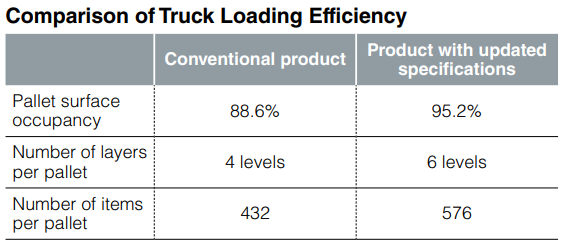
In recent years, the manufacturing and transportation industries have needed to further improve transport efficiency amid diversifying logistics needs, labor shortages, and increasing e-commerce logistics volume. One step that has been taken is improving truck loading efficiency. Improving loading efficiency also contributes to reducing CO2 emissions during product transportation. Accordingly, the NIPPN Group has changed the shape of the packaging for its “Bread Flour Yumechikara Blend” and “Fluffy Bread Flour .” The new packaging retains its ease-of-use with a zipper, while the width at the top has been made slimmer and more compact, improving loading efficiency by more than 130% .
Marine Transportation
Apart from shifting to rail freight transportation, we are also working on shifting to marine freight transportation using ferries. As a result, we have been selected as a certified business operator under the "Eco-Ship Mark Certification System," which certifies that the company contributes to environmental measures through marine transportation.
Initiatives
We recognize that addressing environmental and social issues is not something that can be achieved by the Group alone, and that it is important to form partnerships with many stakeholders. Along with carrying out our own effort, we are also participating in various initiatives both in Japan and overseas.